
WHAT IS A STAINLESS STEEL FLEXIBLE FLANGED HOSE? FLANGED HOSE AND FLEXIBLE FLANGED HOSE SYSTEMS
A stainless steel flexible flanged hose is a critical connection component that ensures safe, flexible, and leak-proof fluid transfer in industrial facilities. Especially in systems exposed to high pressure, temperature, and vibration, flanged hose solutions provide much safer and longer-lasting performance compared to rigid pipeline systems.
Flexible flanged hose systems are widely used for the transfer of steam, hot oil, gas, chemical liquids, air, and various process fluids. Thanks to their stainless steel body, they are resistant to corrosion and can operate safely even under harsh working conditions.
Structure of Stainless Steel Flexible Flanged Hose
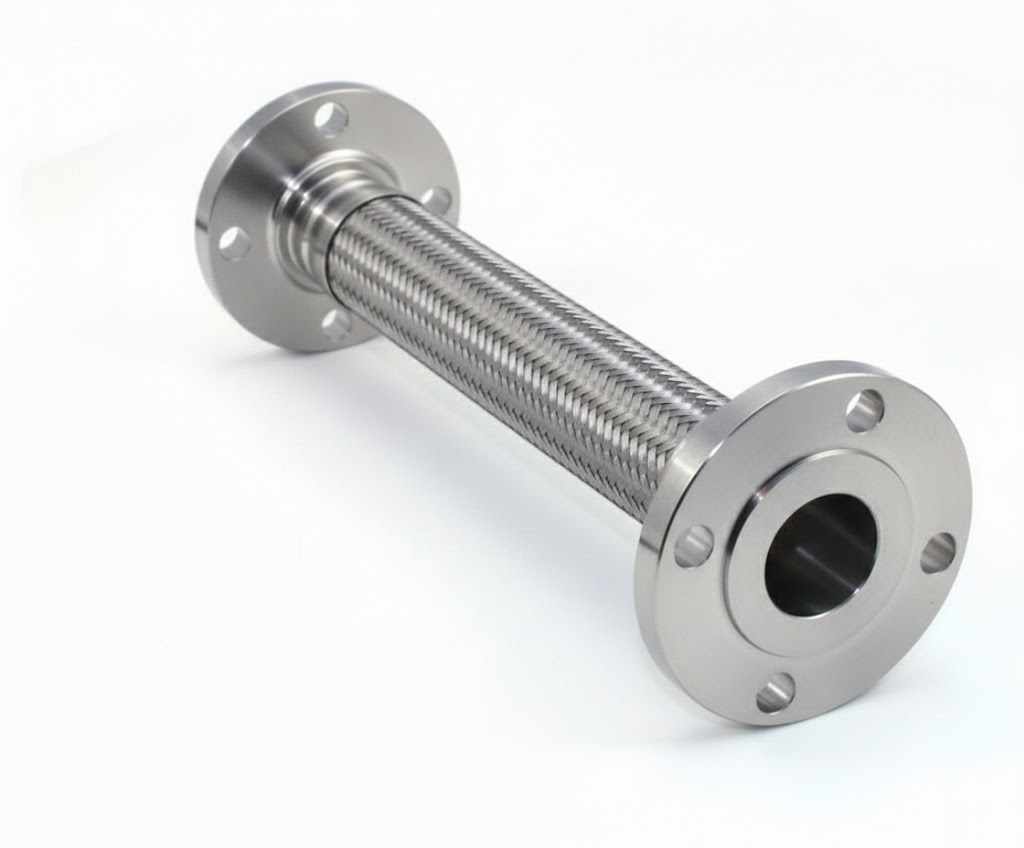
A stainless steel flexible flanged hose basically consists of three main components:
- Stainless steel corrugated inner core
- Outer braided wire (optional double layer)
- Flanged end connections
The corrugated inner structure provides flexibility, while the outer wire braid increases pressure resistance. Flanged hose ends can be manufactured according to DIN, ANSI, EN, or special standards. This structure ensures both mechanical strength and ease of installation.
Why Are Flanged Hoses Preferred?
Flanged hose systems are particularly preferred due to their vibration absorption and expansion compensation capabilities. Thermal expansion and mechanical stress occurring in rigid piping systems may cause cracks and leaks over time. Flexible flanged hoses eliminate this risk.
Main advantages:
- High pressure resistance
- High temperature tolerance
- Corrosion resistance
- Vibration absorption
- Easy installation and maintenance
- Long service life
Applications of Stainless Steel Flexible Flanged Hose
Stainless steel flexible flanged hoses are actively used in many industrial sectors:
Power Plants
Provides safe connections in steam lines and high-temperature systems.
Petrochemical and Refinery Facilities
Preferred in aggressive fluid lines requiring chemical resistance.
Heating and Cooling Systems
Absorbs vibration in boiler connections and HVAC systems.
Food and Pharmaceutical Industry
Can be manufactured in suitable quality grades thanks to its hygienic stainless structure.
Marine and Shipbuilding Industry
Improves system safety by absorbing engine vibrations.
Technical Specifications of Flexible Flanged Hoses
The stainless steel grades commonly used in flexible flanged hose production are AISI 304, AISI 316, or 316L. Pressure resistance varies depending on hose diameter and braid layer count.
The operating temperature range can be between -200°C and +600°C. Pressure values are determined according to project requirements. Flange standards can be manufactured as DIN PN10, PN16, PN25, PN40, or ANSI Class 150 and 300.
How to Select the Right Flanged Hose?
The following criteria must be considered when selecting a flanged hose:
- Operating pressure
- Operating temperature
- Type of conveyed fluid
- Pipe diameter
- Connection standard
- Movement type (axial, lateral, angular)
An incorrectly selected stainless steel flexible flanged hose may lead to system failures and serious safety risks. Therefore, engineering calculations must be performed accurately.
Quality and Certification in Flanged Hoses
Flexible flanged hose products used in industrial systems must comply with international standards. Production in accordance with ISO, CE, and relevant pressure equipment directives is of great importance.
Welding operations should be carried out by qualified personnel, and hydrostatic and leak tests must be performed.
Installation and Maintenance Recommendations
During flanged hose installation, the hose must operate along its natural axis. Twisting and excessive bending reduce service life. Additionally, appropriate gasket selection must be made for flange connections.
Periodic inspections should be conducted to monitor braid damage and sealing condition.
Stainless steel flexible flanged hose systems are indispensable connection elements of modern industrial facilities. Thanks to flanged hose and flexible flanged hose solutions, both safe and long-lasting fluid transfer can be achieved. With proper engineering, quality production, and correct installation, system efficiency can be maximized.
Additional Technical Considerations and Performance Advantages
Beyond their standard structural advantages, stainless steel flexible flanged hoses provide significant operational benefits in demanding industrial environments. Their corrugated design allows them to withstand cyclic movement and repeated thermal expansion without losing structural integrity. This makes them particularly suitable for dynamic systems where continuous start-stop cycles occur.
In high-pressure systems, multi-layer braided flexible flanged hoses increase burst pressure resistance while maintaining flexibility. This balance between strength and elasticity is essential in petrochemical plants, energy facilities, and heavy industrial production lines.
Another critical factor is fatigue resistance. Industrial pipelines are frequently exposed to vibration caused by pumps, compressors, and turbines. Over time, rigid connections may develop stress fractures. A properly engineered stainless steel flexible flanged hose significantly reduces vibration transmission, protecting both equipment and piping infrastructure.
In corrosive environments such as offshore platforms or chemical processing plants, selecting the appropriate stainless steel grade (such as AISI 316L) ensures extended service life. The molybdenum content in 316L enhances resistance to chloride-induced corrosion, which is common in marine applications.
Safety is also a primary concern in industrial design. Flexible flanged hoses provide controlled movement within the system, reducing the risk of sudden pipe rupture due to thermal expansion or pressure surges. This controlled flexibility enhances overall operational reliability.
From a maintenance perspective, flanged connections simplify replacement and inspection procedures. Instead of cutting and rewelding rigid pipes, maintenance teams can quickly disassemble and reinstall flanged hose units, minimizing downtime and operational losses.
In conclusion, stainless steel flexible flanged hose systems are not only connection elements but also critical safety and performance components in industrial engineering. Their ability to handle high pressure, extreme temperatures, vibration, and corrosive environments makes them indispensable in modern process systems.